Shapiro
General Overview
The Shapiro campaign followed the principle of meeting students where they are. Unlike AOC’s campaign where formality was crucial, the Shapiro campaign prioritized content that would engage students on their own level. This meant leaning heavily into trends and humor that was already central to students’ feeds. From “Get Ready With Me” videos to ASMR reels. The thought process was that if students were going to see dozens of posts a day, the campaign needed to catch their attention by being just as entertaining as informative. This positioned Shapiro as not just a candidate, but as someone who understood the culture of and could connect to the students in their own world. The campaign also added the power of humor into our strategy. In a time where social media users are bombarded with extreme content with constant crisis messaging, humor was used to provide information without pushing people into a state of desensitization.
The campaign from the very beginning was meant to be framed as a choice between progressive and moderate positions for the democratic party. This was a challenge for the Shapiro campaign as they struggled to figure out how to make moderation exciting and appealing. While progressive ideas typically come with a sense of moral urgency, moderation requires more work to gain appeal. And in a different way as well. Practicality and compromise with the idea that not every problem needs an extreme solution are central to the ideas of moderation. To emphasize these ideals, the Shapiro media team highlighted his commitment to realistic solutions and his willingness to work across differences preventing flashy and impractical promises. Every post and real was made to frame his distinct position in positive terms. Humor made Shapiro approachable and allowed him to give serious information without the student body becoming hyperpolarized. The campaign worked to make moderation relatable rather than dull. This was especially important because in a time where everyone in the media seems to be screaming for attention, Shapiro was a candidate who could smile and make jokes that were worth listening to.
As the election went on however, a serious flaw in the Shapiro campaign had shown through. The campaign began relying too heavily on social media as its primary source of information. The team’s strategic choice to put Shapiro’s platform and ideals out with posts and reels worked well at first, students were able to learn about Shapiro’s positions without having to attend all the events. But gradually, the campaign began to treat social media as the campaign itself rather than just a tool for communication. This struggle became painfully clear when the campaign needed to respond to false information. At one point during the week, the AOC campaign shared inaccurate claims about Shapiro’s stance on ICE, an issue that mattered deeply to many students. Instead of addressing the misinformation in person during events and talking to students in passing, the Shapiro team went straight to Instagram. A reel was posted. It was well made and effective at reaching students online, but it revealed how the campaign struggled with in person communication and it did not reach those who valued face to face interaction.
The over reliance on media meant that when students asked questions in person, Dylan was not always ready with confident, clear answers. The team had worked so hard on making a good online message that it had neglected delivering the same message in person. In a school election, where personal connections and hallway interactions can make or break a campaign, this was a significant issue.
Exposing Inconsistencies
Throughout the campaign, the Shapiro team didn’t just promote the candidate, they also addressed inaccuracies in the AOC campaign’s messaging. This was not negative campaigning, rather it was ensuring students voted based on facts, not fiction. One post was made in response to AOC’s “Tax the Rich” rhetoric and highlighted an image of her Met Gala dress with the slogan written across the back. The post used a clear side to side comparison of Shapiro’s legislative achievements versus AOC’s unfulfilled promises. Another post used humor and irony to highlight misinformation in AOC’s campaign. And one of the most relevant posts that respond to AOC’s campaign would be a post about Shapiro’s stance on ICE. The post uses direct quotes from the inquirer to fact check claims made by AOC’s campaign and it visually demonstrated that the article had been misinterpreted. Each post was not necessarily designed as an attack but made to be a breakdown so that students could evaluate the campaign claims for themselves.
“Let’s Talk About AOC’s “Tax the Rich Plan”
Rare aesthetic: You somehow cosponsor a bill with no cosponsors
Does Josh Shapiro Support ICE?
Turning Point
As election day grew near, the campaign’s focus shifted. The campaign realized that many students still did not understand what this election was really about. Throughout the week people were constantly asking: “What was this election about”, “What was the point?” Someone even told a team member directly that if the election was about where the Democratic Party should go ideologically, they would vote for AOC, but if it was a Democratic primary where the winner would face a republican for presidency, they would vote for Shapiro. This was a huge wake up call. The theme was clearly not obvious enough and if the voters did not understand the theme they could not make an informed choice.
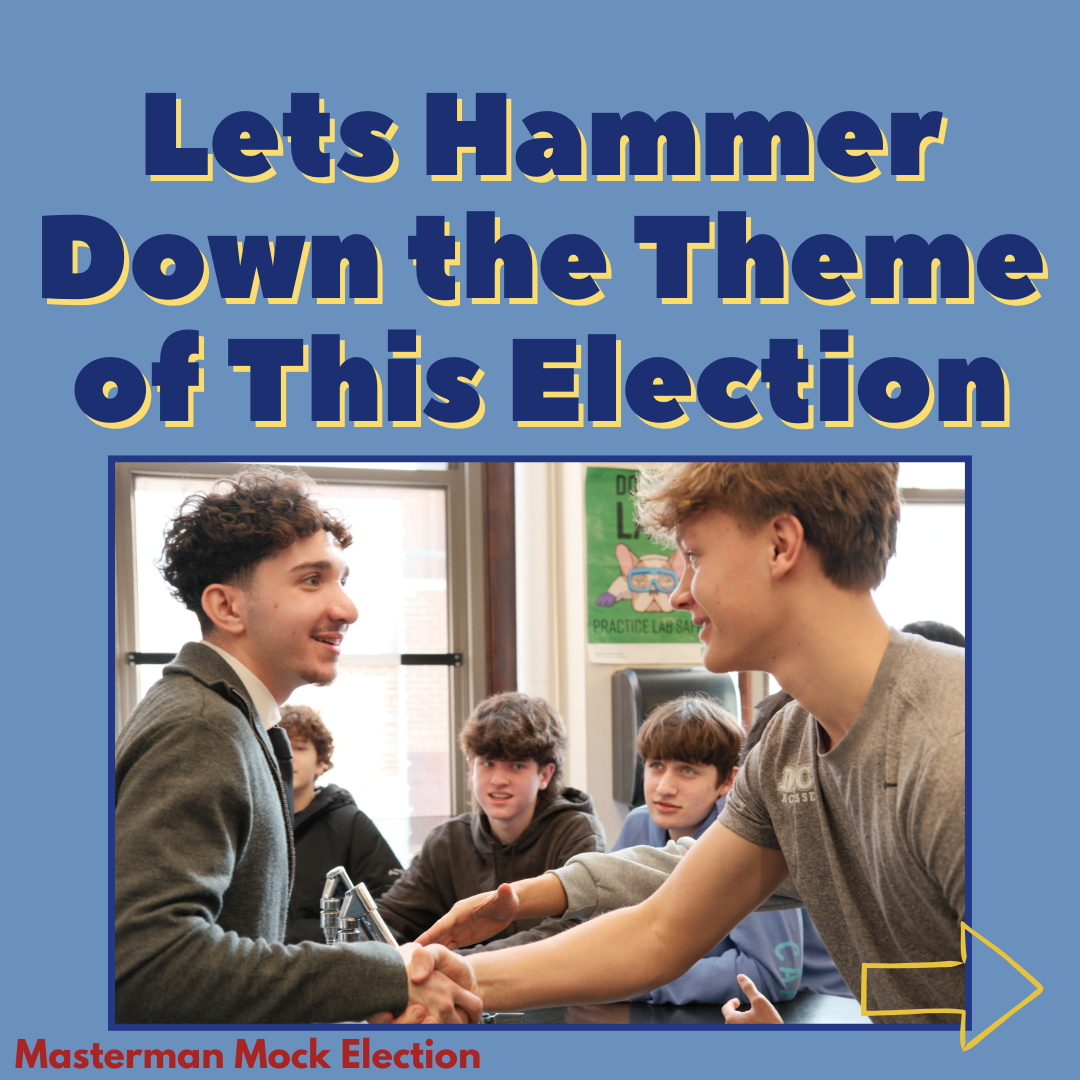
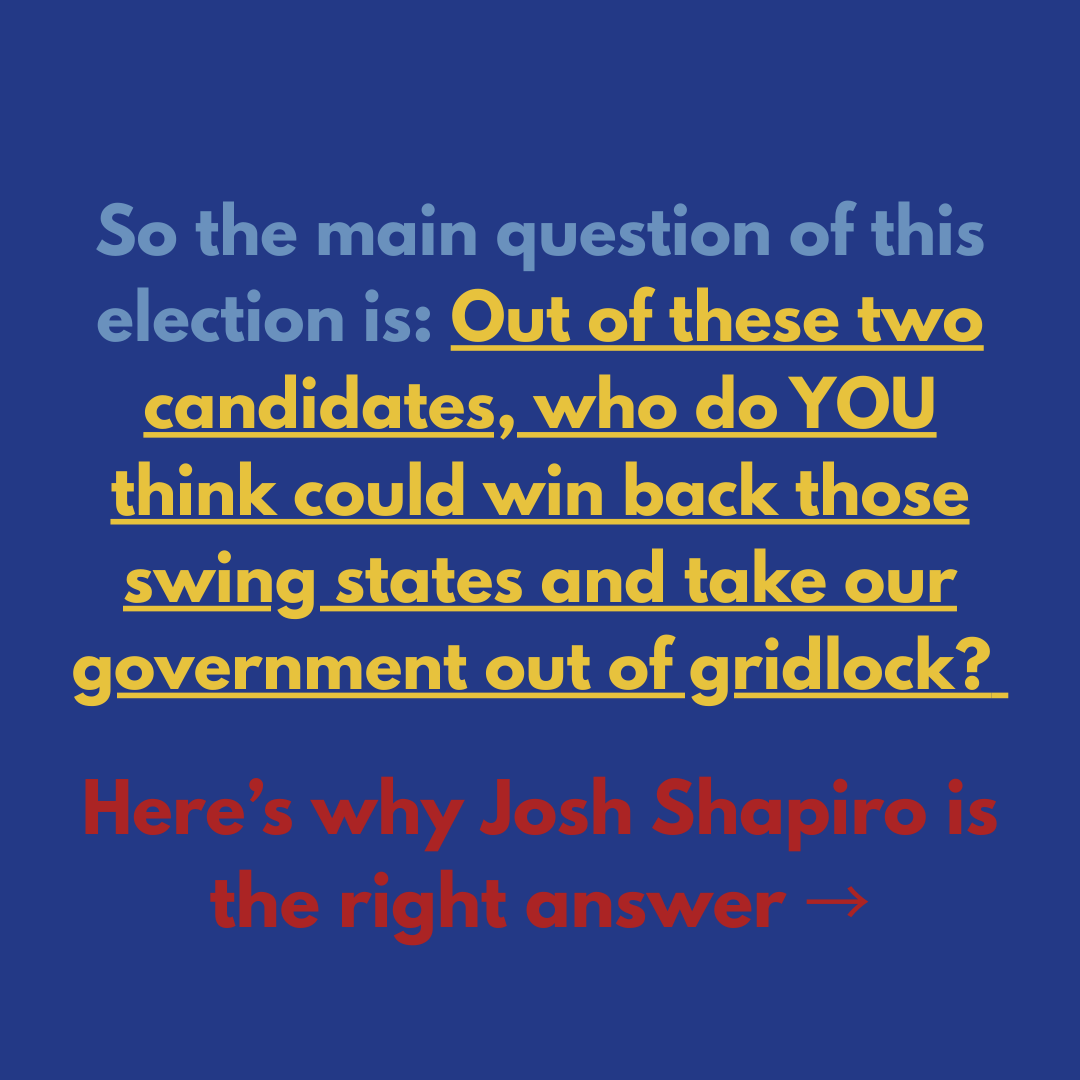
To address this, the campaign created a post to not just inform students, but to reframe it in a way that ultimately made Shapiro the right answer. With the name “Let’s Hammer Down the Theme of this Election,” the post laid out the central question of the campaign: Out of these two candidates, who do you think could win back the swing states and take the government out of gridlock? It connected the mock election to the real 2024 election, where democrats lost all seven swing states and questioned whether the party had moved too far left. The post made it clear that this election was essentially a democratic primary and that the winner would need to appeal to centrist voters without compromising everything. It then made a case for why Shapiro is the right answer. It highlighted his record of passing legislation in a split legislature and his ability to get stuff done while contrasting to AOC’s lack of passed bills. The central message: Progressive policies that can’t pass are simply not realistic solutions.
Another crucial turning point for the Shapiro campaign was surprisingly after the very last event: The debate. The “Vote for Josh” hype video played during the debate was the campaign’s most powerful statement. It highlighted Shapiro’s energy and authenticity. The editing was clean and the music was catchy. The media team immediately uploaded it to Instagram and reposted it everywhere. With the video still fresh in their minds, many shifted their votes towards Shapiro.
Vote for Josh Video
Reflection
The largest strength of the Shapiro campaigns social media presence was its ability to connect with students through trending content. From “Get Ready With Me” videos to “ASMR” reels, the campaign consistently produced content that matched what students were used to seeing everyday. This approach made the campaign feel accessible and fun rather than formal or overly political. Students could tell that the team wanted to meet them where they were already. However, this strength also had its downsides as the campaign sometimes struggled to communicate critical information of Shapiro’s moderate platform as clearly and objectively as it could have. It was not always clear from scrolling through the page what Shapiro actually stood for and why moderation was the better choice in this election.
The campaign also faced challenges around responding to misinformation on the AOC side. When the AOC campaign shared inaccurate information about Shapiro’s stance on ICE, the Shapiro team wanted to respond immediately with a post correcting them. But the decision to respond exclusively online revealed a large issue in the campaign: It was becoming too reliant on social media as its primary mode of communication. When students asked about issues in the campaign in person, the campaign was not always prepared with confident and consistent answers. The assumption became that students would just watch a reel or read a post to get information. But in a school environment where personal connections and hallway interactions can not be replicated with social media posts, the campaign had a serious weakness.
Another challenge was the campaign’s negativity. Before the beginning of the campaigning, the team had discussed the importance of staying positive and not directly attacking the opposing campaign. But as the week went on and other campaigns continued posting misinformation, defending Shapiro and attacking AOC turned into a gray area where one was almost always the other. Some posts that were meant to be factual corrections came across as negative and attacking. This led to moments where the campaign’s response felt reactive rather than strategic.
Despite these challenges, the Shapiro campaign had a powerful ending. The “Vote for Josh” hype video posted right after the debate was the campaign’s strongest piece of content by far. Students responded immediately and the crowd went wild. Showing up to the ballot boxes the following Monday with the video still fresh in their minds caused a clear shift in sentiment.
Task List
For the Shapiro campaign, social media was mostly handled by Omar Aboulatta, Muneerah Chowdhury, and Taylor Samara-Reuter.
Omar Abouelatta was in charge of running the campaign’s social media accounts. This meant he was the one who logged in every day, posted content, and kept an eye on how students were responding. He also made all of the Reels with Taylor. Omar wanted to make reels that would catch students’ attention and make them want to learn more about the campaign. He utilized popular trends to make students engage with the content. From “Get Ready With Me” to “ASMR” videos, using terminology that resonated with our audience group.
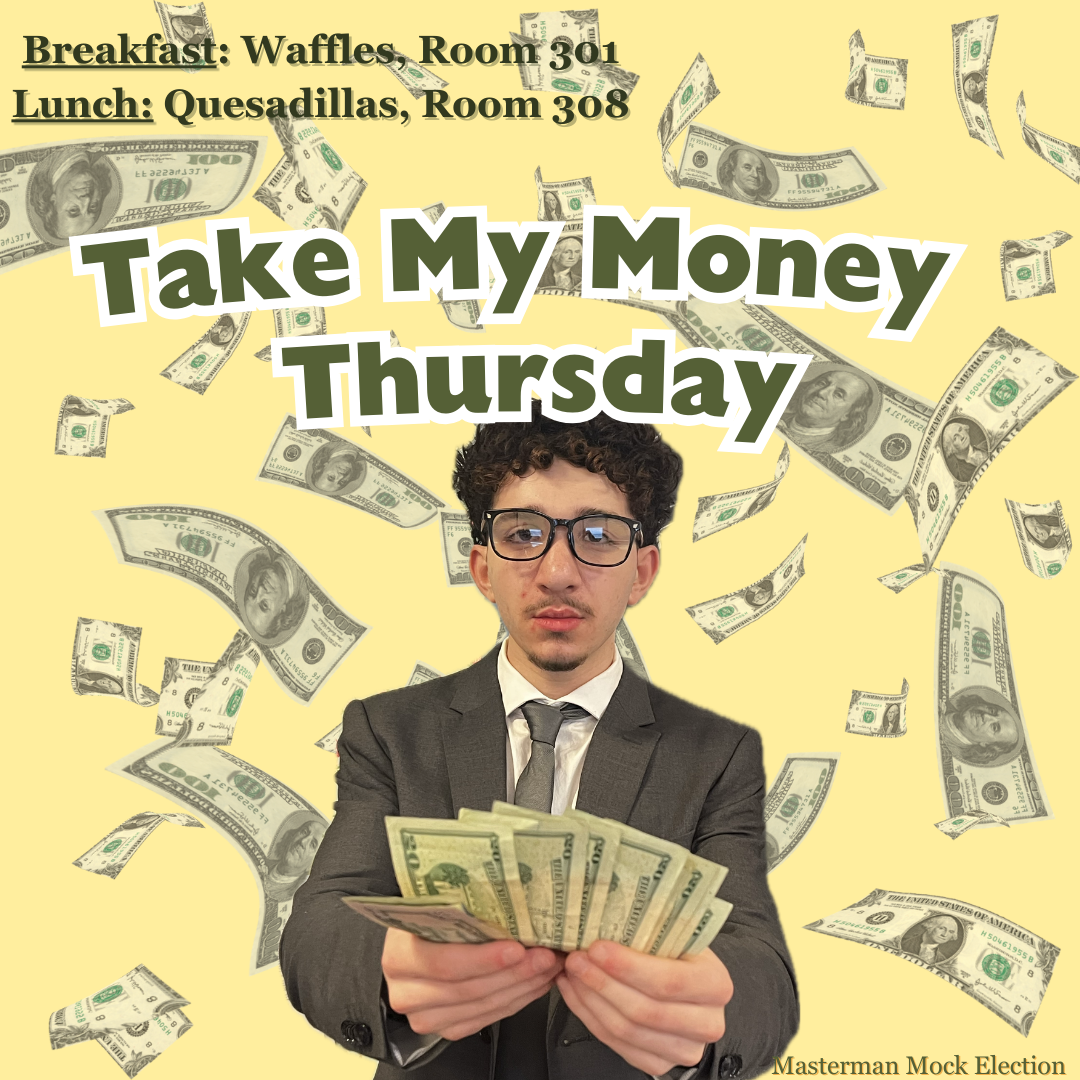
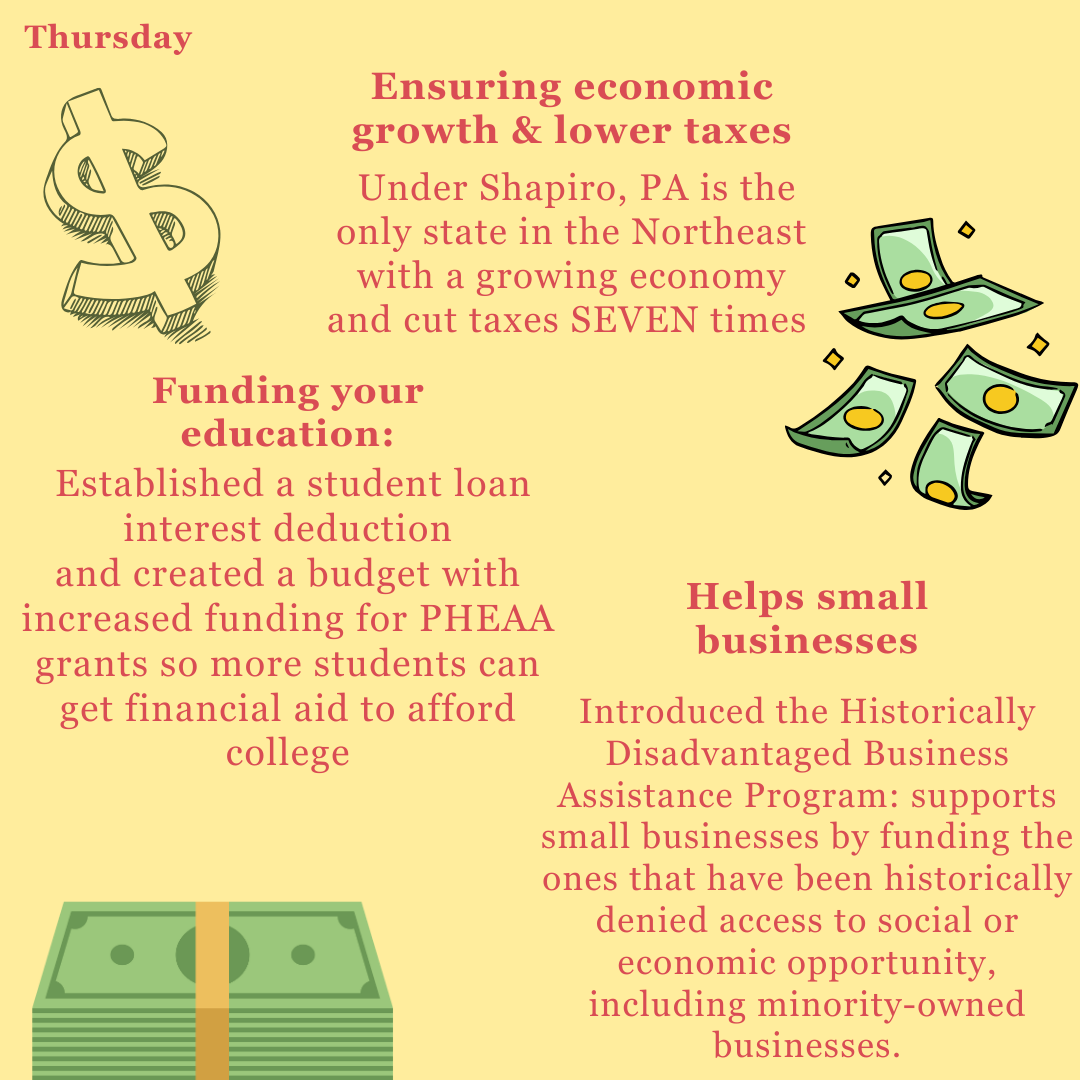
Muneerah Chowdhury focused on designing the posts. Muneerah made sure the campaign’s posts looked good and matched a consistent style. She chose colors, fonts, and layouts that made the campaign easy to recognize and caught people’s attention. She made sure every post stayed within the colors of the campaign, red, blue, and yellow, and that each post used similar fonts like Gaglin and Georgia. If someone scrolled past a post and saw the colors or design, they would know right away it was from the Shapiro campaign. Muneerah also had to follow the one-third rule, making sure her designs did not take up too much space and that there was plenty of room for information. Muneerah emphasized the theme of the daily posts by having Dylan pose in the context of the post, as shown below with the money spread for ‘Take My Money Thursday’.
Taylor Samara-Reuter had the important job of making sure all the information in the posts was correct. Before anything went live, Taylor checked the facts. She made sure information for events were right and that nothing misleading was being shared. She also proofread everything to catch spelling or grammar mistakes. When students saw posts that were well written and fact checked, they trusted the campaign more. Taylor helped the campaign build a reputation for being honest and reliable.
GRWM Video
ASMR Video
Daily Posts
My Plan Monday
Trains on Track Tuesday
Women’s Rights Wednesday
Take My Money Thursday
Fix the Dems Friday